
Quick answer: This free RBT practice exam PDF contains 85 printable multiple-choice questions covering all six content areas of the 2026 RBT Test Content Outline, followed by a complete answer key with explanations. Print it or save it as a PDF to study offline.
How to use this printable RBT exam
- Print the questions (or save as PDF) and set a 90-minute timer.
- Circle one answer per question — don’t look at the answer key.
- Score yourself with the key at the end. Aim for 68/85 (80%) or more.
- Revise weak areas in the RBT study guide.
RBT practice questions (1–85)
Jaycee has a goal to independently mand for preferred items. Which of the following would be the most precise mastery criteria for this goal?
- 10x/session
- 80% independent across 3 consecutive sessions
- 100% accuracy
- All of the above
Sheila is working with a 3-year-old boy. He enjoys playing with toy dinosaurs, so she brings a bag full of toy dinosaurs to her session and allows him to play with them when he earns 5 tokens for following his rules. Toy dinosaurs would be a:
- Generalized conditioned reinforcer
- Conditioned reinforcer
- Primary reinforcer
- Unconditioned reinforcer
Your supervisor asks you to take duration data on your learner’s behavior. What does this mean?
- Recording the number of times your learner engages in a behavior
- Recording the number of times your learner engages in a behavior during a specified duration of time
- Recording the total amount of time your learner engages in a behavior
- Recording the time from the onset of the SD to the start of your learner engaging in a behavior
Response latency is to ____________ as whole interval recording is to ____________.
- Continuous measurement; Discontinuous measurement
- Permanent product recording; Momentary time sampling
- Discontinuous measurement; Continuous measurement
- Continuous measurement; Permanent product recording
Julio records interval data for his student’s classroom participation using 5-minute intervals. During the interval from 8:00-8:05 AM, student A participates in the class work for two minutes. Julio records that interval as a ✅ (or yes/+). Assuming he is entering data accurately, what type of measurement procedure must he be using?
- Whole interval recording
- Momentary time sampling
- Partial interval recording
- Planned activity check
Which of the following is an objective and measurable description of behavior?
- Harriet was mean to her friend
- Harriet was aggressive toward her friend
- Harriet punched her friend’s face with a closed fist
- All of the above
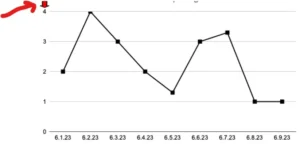
What is the red arrow pointing to in the following graph ?

- The trendline
- The legend
- The X-axis
- The Y-axis
Milana wants to know how much time passes between occurrences of her client asking for a break. What type of data would she collect?
- Response latency
- Rate
- Interresponse time
- Duration
You want to make changes to your own behavior to be healthier. You begin by self-monitoring how often you exercise. During week 1, you record exercising 3x/week and 90 minutes total. What types of measurement did you use?
- Duration and rate
- Duration and count
- Count and latency
- Interresponse time and momentary time sampling
Operational definitions of behavior should be:
- Subjective
- Objective
- Opinion-based
- All of the above
Marlee’s mother gives her a cup of orange juice. Marlee throws the cup and screams. Marlee’s mother says, “What’s wrong? You asked for orange juice!” What was the antecedent in this scenario?
- Marlee’s mother providing a cup of orange juice
- Marlee’s mother asking her what’s wrong
- Marlee asking for the orange juice
- Marlee throwing the cup
Which of the following is true about a free operant preference assessment?
- You present your learner with one item at a time and record their response to it
- You present your learner with two items and allow them to choose one, then record which one they chose
- You observe your learner in a natural setting and record what they choose to play with
- None of these describe a free operant preference assessment
Your BCBA provides your client’s caregiver with a questionnaire to fill out about the child’s behavior to get more information about what they’re seeing outside of therapy sessions. This type of tool falls under which category of assessments?
- Descriptive assessment
- Preference assessment
- Skill assessment
- Indirect assessment
Which of the following describes a multiple stimulus with replacement (MSW) preference assessment?
- Jane observes her learner and records which toys they play with and how long
- Kia offers two toys to her learner and records which one they choose
- Lorraine places 6 toys in an array and records which toy her learner chooses. She allows them to play with it for a minute before taking it away and changing the array with new toys
- Misha place 5 toys in an array and records which toy her learner chooses. She allows them to play with it for a minute before taking it away and instructing her learner to choose another toy
What is the purpose of a preference assessment?
- To identify items and activities that are reinforcing to an individual
- To identify items and activities that an individual likes
- To identify why the individual engages in a particular behavior
- To assess skill deficits
Your BCBA asks you to help him conduct a skill-based assessment (E.g., VB-MAPP, ABLLS) with your shared client. Which of the following best describes how you would conduct the assessment?
- Provide the instruction for the skill, then immediately prompt the correct response
- Provide the instruction for the skill, do not prompt, but go through error correction if the learner errors
- Provide the instruction for the skill, allow your learner to respond, and record data on their response
- Provide the instruction for the skill, prompt as needed, and reinforce correct responding
In what type of assessment would you record ABC data?
- Functional analysis
- Descriptive assessment
- Skill-based assessment
- Indirect assessment
How many items are presented in a paired choice preference assessment?
- 1
- 3
- 6-8
- 2
When recording ABC data, what information must be recorded? Choose the best response.
- The setting events, the function of the behavior, and the behavior’s consequence
- What the behavior looked like and why the learner engaged in the behavior
- Who was present and at what time the behavior occurred
- What occurred right before the behavior, what the behavior looked like, and what happened right after the behavior
What is a baseline measure?
- A measurement of the behavior or skill before implementation of the intervention
- A measurement of the behavior or skill after the intervention is complete
- A measurement of the behavior or skill at each specified interval during intervention
- A measurement not commonly used in ABA
An RBT records whether a learner is on task only at the exact moment each 1-minute interval ends. Which data collection method is this?
- Partial interval recording
- Whole interval recording
- Momentary time sampling
- Frequency recording
Which of the following is the best example of a generalized conditioned reinforcer?
- A cookie
- A drink of water
- Money
- A favorite toy car
Your BCBA reviews a new goal with you. They instruct you to use a continuous schedule of reinforcement for this goal. What does this mean?
- You provide reinforcement non-contingently
- You reinforce some, but not all, occurrences of the behavior
- You reinforce every occurrence of the behavior
- You do not reinforce this behavior
Your favorite ice cream spot offers punch cards where you can earn a free scoop of ice cream. Each purchase earns you one punch on the punch card. Once you receive 5 punches on your card, you get your next scoop free! What schedule of reinforcement would this exemplify?
- Continuous reinforcement
- Fixed interval
- Variable ratio
- Fixed ratio
_________________ reinforcement occurs when a reinforcer is presented regardless of whether the target behavior is demonstrated or not.
- Noncontingent
- Conditioned
- Continuous
- Intermittent
Which of the following is not included in a written skill acquisition plan?
- Materials for teaching the skill
- Mastery criteria
- A description of the behaviors targeted for reduction
- A description of the skill being taught
Which schedule of reinforcement is used when reinforcement is provided after an average amount of time has passed?
- Fixed ratio
- Fixed interval
- Variable ratio
- Variable interval
You are running discrete-trial-teaching to teach your learner a new skill of identifying emotions exhibited on 2D picture cards. You hold up a picture card of a girl smiling and ask “how does she feel?” At what point would you prompt the correct response?
- After the learner answers incorrectly
- When the learner does not respond
- A or B
- Before the learner responds
What type of reinforcers get their reinforcing value by being paired with other reinforcers?
- Primary reinforcers
- Unconditioned reinforcers
- Conditioned reinforcers
- Continuous reinforcers
Meeka is teaching her client to mand using PECS. Because her client is highly motivated for cheese-it crackers, she uses these to teach the contingency of exchanging the picture icon to receive the crackers. Cheese-it crackers fall under which type of reinforcer?
- Primary
- Conditioned
- Secondary
- None of the above
_______________ teaching occurs in a learner’s natural environment, using naturally occurring learning opportunities.
- Task-analyzed
- Incidental
- Discrete-trial
- Shaping
Which type of chaining procedure consists of prompting each step until the final step, which the learner then completes independently?
- Backward
- Total task
- Forward
- Cross-sectional
You can achieve stimulus control through the process of:
- Discrimination training
- Generalization training
- Maintenance training
- Discrete-trial-training
Dana is teaching her client, Joey, to receptively identify body parts on himself. She provides the SD “touch your head.” When Joey touches his head, she delivers verbal praise and a high-five. When given this instruction and Joey touches his nose, she does not deliver praise or a high-five. Dana is conducting:
- Stimulus class training
- Discrimination training
- Stimulus control transfers
- Prompt fading
VR, FR, VI, and FI are all:
- Types of behavior intervention procedures
- Continuous schedules of reinforcement
- Types of teaching procedures
- Intermittent schedules of reinforcement
Shay is learning to label colors. Which of the following examples would exemplify naturalistic teaching to learn colors?
- While playing with blocks on the living room floor, Shay reaches for a block. The RBT holds it up and asks “What color?” Shay says “blue” and is given the block to play with
- While sitting at a table in the therapy room, the RBT presents a 2D color card and asks “What color?” Shay responds with the color, then earns a token
- While sitting at a table in the therapy room, the RBT clears the table, shows Shay a red Lego and asks “What color?” Shay responds “red”, then earns reinforcement
- All of the above are naturalistic teaching examples
When teaching your client to match 2D identical pictures, you start by providing a hand-over-hand prompt so that they are successful. After a few sessions of this, you fade your prompt to partial physical, then to gestural, until your client is successful matching pictures without any prompting. By fading your prompts, you are:
- Thinning reinforcement
- Transferring stimulus control
- Prompting
- Generalizing the skill
You lay out 3 small objects and provide the instruction “find the ____.” Which of the following prompts would be the least intrusive in this example?
- Positional
- Hand over hand
- Partial physical guidance at the client’s elbow
- Partial physical guidance at the client’s wrist
Your BCBA asks you to create a task analysis for tying shoes. What does this mean?
- You record data on your client’s ability to tie their shoes
- You make a data sheet for tying shoes
- You break down the skill of tying shoes into several individual steps
- You systematically reinforce successive approximations toward an end goal
Providing assistance following the SD to ensure your learner responds accurately is _________________.
- Shaping
- Prompting
- Chaining
- Task analyzing
In a token economy, the items or activities the learner cashes in their tokens for are called:
- Backup reinforcers
- Tokens
- Primary reinforcers
- Extra reinforcers
You taught your client to label a refrigerator on a 2D picture card. The next day, your client’s mother informs you that he has been pointing to refrigerator in their kitchen and saying “refrigerator!” What does this demonstrate?
- Maintenance
- Generalization
- Shaping
- Behavior modification
______________ occurs when an intervention is removed, but the client continues to demonstrate the skill.
- Maintenance
- latency
- Generalization aross stimuli
- Behavior modification
Derick creates a token economy for his students. He identifies the behaviors that he wants to target, chooses the tokens that will be used, and creates a backup reinforcer menu for the students to cash in their tokens for, with a specified number of tokens needed for each item. What step does he need to add before reviewing and implementing this with his students?
- Choosing whether to use stickers, stars, tallies, or another type of token
- Specifying how many tokens are needed in order to cash in
- Specifying a reinforcer schedule for the tokens
- No steps are missing
Your client is working on a multiple-step household chore. Your BCBA instructs you to teach this skill using a chaining procedure. The chore consists of 7 steps. At baseline, your learner can do 5 out of the 7 steps independently. Which type of chaining procedure would you use?
- Forward
- Total task
- Backward
- Any of the above would be appropriate
Manny learns to urinate using a toddler toilet at his home during therapy sessions. When he mastered this skill, his therapy team began having him use the family’s toilet and, when out in the community, tried taking him to public restrooms. Manny would not urinate in any toilet other than his toddler toilet at home, exemplifying a lack of ______________ of this skill.
- Social validity
- Stimulus control
- Generalization
- Maintenance
Lynnette earns stickers for following rules during therapy sessions. When she earns 10 stickers, she can choose a prize from the prize box. What type of procedure does this exemplify?
- Automatic contingency
- Token economy
- Stimulus control transfer procedure
- Generalization
You review a skill acquisition plan for a receptive identification of 3D objects goal, which states to provide most-to-least prompting. Which type of prompt would you likely start with?
- HOH
- Guiding client’s hand
- Pointing
- Partial verbal
In an FR5 schedule of reinforcement, the reinforcer would be provided:
- Every 5 minutes
- Every 3-7 minutes
- Every 5 occurrences of the behavior
- Every 3-7 occurrences of the behavior
Sarah gives her daughter a sticker when she uses the toilet independently. Her daughter continues increasing her independence with using the toilet independently. This exemplifies _____________
- A token economy
- Positive reinforcement
- Negative reinforcement
- None of the above
Lola has a BIP targeting aggressions. The function of her aggressions is hypothesized to be access to attention. Which of the following would be the most appropriate replacement behavior to be included in her BIP, given this information?
- Ignore and redirect when aggressions occur
- Teach Lola to say “hi (person’s name)” to get their attention
- Teach Lola to mand for preferred items and activities
- Do not allow Lola to get out of demands by engaging in aggressions
What is an antecedent intervention?
- A strategy for preventing target behaviors
- A way to operationally define target behaviors
- A strategy for responding to target behaviors
- A key component in a skill acquisition plan
Which of the following reasons for a particular behavior would not fall under the main functions of behavior?
- To get someone to play with you
- Because you wanted to
- Because it physically felt good
- To avoid an unpleasant situation
Which of the following scenarios constitutes the need for a crisis intervention to be included in your learner’s behavior reduction plan?
- Your learner engages in echolalia
- Your learner engages in occurrences of repetitive, high-pitched screams
- Your learner engages in attempted elopements from the home
- All of the above would require a crisis intervention
A discriminative stimulus indicates:
- A demand
- A consequence
- The availability of reinforcement
- The presence of a punisher
You are starting with a new client who engages in several dangerous behaviors. Where can you locate the procedures for how to prevent and respond to these behaviors?
- Skill acquisition plan
- Replacement behavior program
- Behavior reduction plan
- Manding write-up
Stimulus changes in the environment that occur right before a behavior are referred to as _________________.
- Motivating operations
- Discriminative stimuli
- Consequences
- Antecedents
The functions of behavior include:
- Sensory, attention, access
- Automatic reinforcement, access to tangibles, escape, attention
- Control, attention, escape, sensory
- Control, automatic reinforcement, attention, tangibles
You have had a migraine all day long. You try to relax, but it doesn’t go away. You finally give in and take an Excedrin. What is most likely the function of your behavior of taking an Excedrin?
- Escape
- Attention
- Automatic reinforcement
- Access to tangibles
Penelope gets overstimulated in loud settings and begins screaming and running away, which can be dangerous because she does not have safety awareness. Choose the most appropriate antecedent intervention to support Penelope.
- Never go into public settings with Penelope
- Provide access to noise-reducing headphones before entering a potentially loud setting
- Ignore Penelope’s screams and block escapes
- Teach Penelope to mand for a break when she is in an overstimulating setting.
Stimulus changes that occur right after a behavior are referred to as:
- Antecedents
- Extinction
- Consequences
- Reinforcements
Kevin hits his peers at preschool to get their attention. His team implements a procedure where everyone limits attention toward Kevin when he hits his peers. Instead, he receives verbal praise when engaging in behaviors that keep his hands busy. Clapping, playing with legos, etc. What type of procedure does this entail?
- Differential reinforcement of alternative behaviors
- Differential reinforcement of incompatible behaviors
- Differential reinforcement of other behaviors
- Differential reinforcement of low levels of behaviors
When using extinction, you:
- Ignore the client
- Provide differential reinforcement
- Withhold reinforcement for a behavior that was previously reinforced
- Ignore all inappropriate behaviors
Which of the following variables would not be necessary to communicate with your BCBA immediately?
- Your client became ill during the session, so you ended the session 45 minutes early
- Your client mastered one of their programs
- Your client’s caregivers reported concerns about their progress and another RBT’s performance
- Your client started a new medication
In a DRO, you reinforce:
- All behaviors noncontingently
- All behaviors other than the behavior targeted for reduction
- An incompatible behavior
- More appropriate alternative behaviors
Your client’s parent tells you to run a program differently than how your BCBA originally trained you. How should you proceed?
- Agree and change the program, since parents know their child best
- Politely explain that you need to run the program as your BCBA designed it, and pass the request on to your BCBA promptly
- Firmly refuse and end the session
- Ignore the request and continue the session
Henry had a particularly challenging session with his new client, Mia. After the session, he reaches out to his BCBA to request guidance. He sends her a secure message on their HIPAA-compliant communication platform. Choose the most appropriate way for Henry to communicate these concerns.
- Mia had an awful session. I have no idea what to do moving forward.
- Mia’s behaviors are escalating and I feel out of control. She clearly doesn’t like me and I don’t know how to remedy this. Are you able to overlap my next sessions to provide more guidance?
- Mia engaged in 27 aggressions and 12 SIBs today, which was significantly higher than I observed during training. I followed the BIP, but I am unsure whether I’m doing things correctly. Could you overlap my next session to provide guidance?
- Since he used a secure communication platform, any of the above ways of communicating his concerns would be appropriate
Pam is working with a 7-year-old client named Lincoln. Lincoln engages in behaviors to escape non-preferred work tasks. How might Pam use a DRA to reduce Lincoln’s escape behaviors? Choose the best solution given this scenario.
- Allow Lincoln to escape non-preferred tasks by manding for a break
- Ignore all escape behaviors and reinforce all other behaviors
- Reinforce on-task behaviors
- Implement escape extinction and forced follow through
Which of the following is the most objective statement for a session note?
- Client struggled to attend and listen during today’s session.
- I could not get the client to attend to learning opportunities despite using the intervention strategies outlined in their BIP.
- Client demonstrated low rates of attention today. Prompts were needed for all goals due to inattention, resulting in 0% independent responding.
- All of the above are objective
Which of the following scenarios would constitute a mandated reporting situation?
- Your client’s father begins giving her coffee because he believes it will help improve her concentration
- Your client does not have many toys or books at home
- You observe your client’s mother throw her against a wall in response to the client engaging in aggressive behavior
- These are all mandated reporting scenarios
Client documentation is required to be saved for a minimum of ___ years
- 5
- 1
- 10
- 7
Your client has sessions in two locations. On Mondays, Wednesdays, and Thursdays, they have sessions at home. On Tuesdays and Fridays, they have sessions in the clinic. How could you transport your client’s session notes and data sheets from their home to the clinic? Choose the best possible response.
- You should not ever transport client documentation
- In a locked box in your trunk
- In your backseat
- In your locked trunk
Which of the following most closely represents the role of the RBT in the ABA service delivery?
- To diagnose individuals with autism and provide treatment to address their individualized needs
- To work 1:1 or in groups, implementing treatment and behavior goals as created by the BCBA
- To create and implement interventions to reduce challenging behaviors
- To assess and treat skill deficits and behavioral needs
Under the BACB’s 2026 requirements, when must an RBT applicant complete the Initial Competency Assessment?
- After passing the RBT exam
- Before starting the 40-hour RBT training
- After completing the 40-hour training, and no more than 90 days before submitting the certification application
- Only if the supervising BCBA has concerns about the applicant’s skills
Your supervisor provides you constructive feedback on how you implemented a manding goal. You are confused, as another supervisor previously trained you to do it this way. Choose the best way for you to respond to this feedback.
- Say “okay” and begin doing it how this supervisor told you to
- Brush it off and continue doing it how you were initially trained
- Tell them that they’re wrong and you know you’re doing it correctly
- Say, “Thanks for the feedback. Could you provide additional clarification, as another supervisor originally trained me to do it this way?”
Which of the following situations does not constitute a dual relationship?
- You provide ABA services for a client during the week and babysit for the family on the weekend
- Your client’s father is your husband’s best friend
- You provide therapy at a client’s home and in the community (e.g., the grocery store, the park)
- You send your client’s mom a friend request on Facebook, where you occasionally like and comment on each other’s posts.
Your client’s dad asks if you have ever worked with a client on teaching them to tie their shoes. You tell him you have worked on this skill with two other clients. He asks you to teach his son as well. How should you respond?
- Agree to do so and immediately begin targeting this skill based on how you did it with other clients
- Tell him you’ll let the case supervisor know he’s interested in targeting shoe tying and wait until a goal is in place before targeting the skill
- Agree to start targeting the skill based on how you’ve done it before, but inform your supervisor that he wants this skill targeted
- Tell him that shoe tying is not an appropriate goal for his son at this time, as he’s not meeting fine motor skill prerequisites
You work 1:1 with client A 12 hours per week and with client B 8 hours per week. What is the minimum number of hours of supervision you must receive each month?
- 1 hour
- 4 hour
- 10 hour
- 5 1/2 hour
Which of the following would not need to be documented in a daily session note?
- The date and time
- Who was present during the session
- Maladaptive behaviors demonstrated
- The behavior intervention plan procedures
Which of the following is a setting event that could impact your client’s response to treatment?
- You provide a non-preferred instruction
- Your client is reported to be ill, with a cough and runny nose
- You ask your client to take turns with their brother
- You remove access to an item that your client was playing aggressively with
During a session, your client’s mother asks you to babysit her children on Saturday night for extra pay. What should you do?
- Accept, because it is outside your work hours
- Politely decline because it would create a multiple relationship, and let your supervisor know about the request
- Accept, as long as your supervisor does not find out
- Accept, but do not charge for babysitting
You say “Clap your hands,” then clap your own hands so the learner can see how to do it. What type of prompt is this?
- Gestural prompt
- Model prompt
- Partial physical prompt
- Positional prompt
A learner’s screaming has been maintained by attention. The team begins planned ignoring of screaming, and during the first few days the screaming becomes louder and more frequent. What is this called?
- Spontaneous recovery
- An extinction burst
- Positive punishment
- Satiation
Two observers count a learner’s hand-raising during the same session. Observer 1 records 18 and Observer 2 records 20. What is the total count IOA?
- 80%
- 90%
- 95%
- 100%
You notice a mistake in yesterday’s paper session note. What is the correct way to fix it?
- Cover the error with correction fluid and rewrite it
- Tear out the page and write a new note
- Draw a single line through the error, write the correction, and add your initials and the date
- Leave it, because notes cannot be changed after the session
Answer key with explanations
- B) 80% independent across 3 consecutive sessions — A precise mastery criterion states the level of performance, the type of response (independent) and how long it must be maintained. “80% independent across 3 consecutive sessions” specifies all three; the other options leave out independence or a time frame, or set an unrealistic standard.
- B) Conditioned reinforcer — Toys are conditioned (learned) reinforcers: their value comes from learning, not from biological need, so they are not primary/unconditioned reinforcers like food or water. They are not generalized conditioned reinforcers either, because they are not exchangeable for many other reinforcers — the tokens play that role here.
- C) Recording the total amount of time your learner engages in a behavior — Duration data measures how long a behavior lasts — the total time from onset to offset. Counting occurrences is frequency, counting per unit of time is rate, and time from the SD to the start of the response is latency.
- A) Continuous measurement; Discontinuous measurement — Latency is recorded for every occurrence (the time from an SD to the start of a response), so it is a continuous measurement. Whole interval recording samples behavior in intervals, so it is a discontinuous measurement.
- C) Partial interval recording — Partial interval recording scores an interval if the behavior occurs at any point during it. Participating for 2 of the 5 minutes earns a “yes” under partial interval, but would not count under whole interval (entire interval) or necessarily under momentary time sampling (end of interval only).
- C) Harriet punched her friend’s face with a closed fist — An objective, measurable description states what a person did in observable terms. “Punched her friend’s face with a closed fist” can be seen and counted; “mean” and “aggressive” are subjective labels that two observers might interpret differently.
- D) The Y-axis — On a standard line graph, the vertical axis is the Y-axis (ordinate) and shows the measured behavior, such as frequency or percentage. The horizontal X-axis (abscissa) shows time, such as sessions or dates.
- C) Interresponse time — Interresponse time (IRT) is the time between the end of one response and the start of the next occurrence of the same behavior — here, the time between requests for a break. Latency is measured from an SD to a response, and duration is how long a single response lasts.
- A) Duration and rate — “3 times per week” is a count over a time period, which is rate. “90 minutes total” is the amount of time exercising, which is duration.
- B) Objective — Operational definitions must be objective: they describe behavior in observable, measurable terms so that any two observers would agree on whether it occurred. Subjective or opinion-based descriptions lead to unreliable data.
- A) Marlee’s mother providing a cup of orange juice — An antecedent is what happens immediately before the behavior. Being given the cup of orange juice came right before Marlee threw the cup and screamed. Throwing the cup is the behavior, and her mother’s question afterward is a consequence.
- C) You observe your learner in a natural setting and record what they choose to play with — In a free operant preference assessment, the learner has free access to items in a natural setting and the observer records what they engage with and for how long. Presenting one item at a time is a single-stimulus assessment; presenting two is paired-stimulus.
- D) Indirect assessment — Questionnaires, interviews and rating scales completed by caregivers are indirect assessments: information is gathered from people who know the client rather than by directly observing the behavior. Direct descriptive assessment involves observing and recording behavior, such as ABC data.
- C) Lorraine places 6 toys in an array and records which toy her learner chooses. She allows them to play with it for a minute before taking it away and changing the array with new toys — In a multiple stimulus with replacement (MSW) assessment, several items are presented in an array; the item chosen stays available and the items that were not chosen are replaced with new ones for the next trial. In MSWO (without replacement), the chosen item is removed and the learner chooses from what remains.
- B) To identify items and activities that an individual likes — A preference assessment identifies items and activities a person prefers, which can then be used as potential reinforcers. Confirming that an item actually increases behavior requires a reinforcer assessment, and explaining why behavior occurs is the job of a functional assessment.
- C) Provide the instruction for the skill, allow your learner to respond, and record data on their response — During a skill-based assessment such as the VB-MAPP or ABLLS-R, the goal is to find out what the learner can already do independently. You give the instruction, let the learner respond without prompting or correction, and record the response. Prompting or correcting would hide their true skill level.
- B) Descriptive assessment — ABC recording is a descriptive assessment: the observer directly watches and records what happens before and after behavior in the natural environment. A functional analysis is experimental, and an indirect assessment relies on interviews or questionnaires.
- D) 2 — A paired-stimulus (forced-choice) preference assessment presents two items at a time, and every item is eventually paired with every other item to build a preference hierarchy.
- D) What occurred right before the behavior, what the behavior looked like, and what happened right after the behavior — ABC data records three things: the antecedent (what occurred right before), the behavior (what it looked like) and the consequence (what happened right after). RBTs record what they observe; deciding the function of the behavior is the supervising BCBA’s role.
- A) A measurement of the behavior or skill before implementation of the intervention — Baseline is a measure of the behavior or skill before any intervention begins. It gives a point of comparison, so the team can tell whether the intervention is changing behavior.
- C) Momentary time sampling — Momentary time sampling records whether the behavior is happening at the exact moment an interval ends. Partial interval scores behavior that occurs at any point in the interval, whole interval requires it throughout the interval, and frequency counts every occurrence.
- C) Money — A generalized conditioned reinforcer has been paired with many other reinforcers and can be exchanged for them. Money and tokens are classic examples. Food and water are primary reinforcers, and a single toy is a conditioned reinforcer, but not a generalized one.
- C) You reinforce every occurrence of the behavior — A continuous reinforcement schedule (CRF, or FR1) reinforces every occurrence of the target behavior. It is used when teaching a new skill; reinforcing only some occurrences is intermittent reinforcement.
- D) Fixed ratio — A fixed ratio (FR) schedule delivers reinforcement after a set number of responses. Here every 5th purchase earns a free scoop, which is FR5. A variable ratio would change the number of responses needed, and interval schedules depend on time passing.
- A) Noncontingent — Noncontingent reinforcement (NCR) delivers a reinforcer on a time-based schedule regardless of behavior. It is often used as an antecedent intervention to reduce motivation for problem behavior maintained by the same reinforcer.
- C) A description of the behaviors targeted for reduction — A skill acquisition plan describes the skill being taught, the teaching materials and procedures, and the mastery criteria. Behaviors targeted for reduction belong in a behavior reduction (behavior intervention) plan.
- D) Variable interval — A variable interval (VI) schedule reinforces the first response after an average amount of time has passed, with the interval varying around that average. A fixed interval uses the same amount of time every time; ratio schedules depend on the number of responses.
- D) Before the learner responds — When teaching a brand-new skill with errorless learning, you prompt immediately — before the learner can respond incorrectly — so they contact reinforcement for the correct answer. Prompts are then faded systematically.
- C) Conditioned reinforcers — Conditioned (secondary) reinforcers gain their value by being paired with other reinforcers — for example, praise or tokens paired with preferred items. Primary (unconditioned) reinforcers such as food and water need no learning history.
- A) Primary — Food is a primary (unconditioned) reinforcer because its value is biological and does not depend on a learning history. Crackers are effective here because the learner is motivated for them.
- B) Incidental — Incidental teaching uses naturally occurring opportunities in the learner’s environment, often following the learner’s interests, to teach skills. Discrete trial teaching is more structured and adult-led.
- A) Backward — In backward chaining, the instructor prompts or completes every step except the last one, which the learner completes independently. Once the last step is mastered, the learner completes the last two steps, and so on, so they always finish the task and contact the natural reinforcer.
- A) Discrimination training — Stimulus control is established through discrimination training: a response is reinforced in the presence of the SD and not reinforced in its absence (S-delta), so the learner learns to respond only when the SD is present.
- B) Discrimination training — Dana reinforces touching the head when the SD “touch your head” is given, and withholds reinforcement for other responses such as touching the nose. Reinforcing the correct response and not others is discrimination training.
- D) Intermittent schedules of reinforcement — Variable ratio, fixed ratio, variable interval and fixed interval are all intermittent schedules of reinforcement: only some responses are reinforced. Continuous reinforcement reinforces every response.
- A) While playing with blocks on the living room floor, Shay reaches for a block. The RBT holds it up and asks “What color?” Shay says “blue” and is given the block to play with — Naturalistic teaching (NET) happens in the learner’s natural environment, follows their interests and uses natural reinforcers. Asking about the color of a block Shay is reaching for, then giving her the block, is naturalistic. Table work with cards or Legos and tokens is structured discrete trial teaching.
- B) Transferring stimulus control — Fading prompts from hand-over-hand to partial physical to gestural transfers stimulus control from the prompt to the natural SD (the instruction and materials), so the learner responds independently.
- A) Positional — A positional prompt — placing the correct item closer to the learner — is the least intrusive option listed. Physical prompts (hand-over-hand, or partial physical at the elbow or wrist) are much more intrusive.
- C) You break down the skill of tying shoes into several individual steps — A task analysis breaks a complex skill, such as tying shoes, into small, teachable steps in order. Those steps are then taught using chaining. Reinforcing successive approximations is shaping.
- B) Prompting — A prompt is extra assistance given after (or with) the SD to increase the chance of a correct response — for example a gestural, model or physical prompt. Prompts are faded over time.
- A) Backup reinforcers — Backup reinforcers are the items or activities a learner exchanges tokens for. Tokens become conditioned reinforcers because they are paired with backup reinforcers.
- B) Generalization — Generalization is when a skill occurs outside the teaching conditions — with different materials, people or settings. Learning “refrigerator” from a picture card and then labeling the real refrigerator at home shows stimulus generalization.
- A) Maintenance — Maintenance means a behavior continues after the intervention or teaching has been removed. Generalization refers to the behavior occurring across new settings, people or stimuli.
- C) Specifying a reinforcer schedule for the tokens — Besides choosing target behaviors, tokens, backup reinforcers and exchange prices, a token economy needs a schedule for delivering tokens — how and when tokens are earned (for example, one token per correct response, FR1). Without it, tokens would be delivered inconsistently.
- B) Total task — Total task chaining teaches every step of the chain in each session, with prompts only where needed. It suits learners who can already do many of the steps — here 5 of 7 — or tasks that are not too long.
- C) Generalization — Using the toilet only at home and not in other bathrooms shows a lack of generalization across settings and stimuli. Generalization should be planned by teaching with varied materials, people and locations.
- B) Token economy — Earning stickers (tokens) that can be exchanged for a backup reinforcer from a prize box is a token economy, a system built on conditioned reinforcement.
- A) HOH — Most-to-least prompting starts with the most intrusive prompt needed to ensure success — usually full physical (hand-over-hand) — then fades to less intrusive prompts as the learner becomes successful.
- C) Every 5 occurrences of the behavior — Fixed ratio 5 (FR5) means reinforcement is delivered after every 5th occurrence of the behavior. Time-based schedules (every 5 minutes) are interval schedules, and “every 3–7 occurrences” describes a variable ratio.
- B) Positive reinforcement — A sticker is added after toileting and the behavior increases, so this is positive reinforcement (“positive” means a stimulus is added). A single sticker is not a token economy unless it can be exchanged for backup reinforcers.
- B) Teach Lola to say “hi (person’s name)” to get their attention — A replacement behavior should serve the same function as the problem behavior. Lola’s aggression is maintained by attention, so teaching her an appropriate way to get attention (saying “hi” plus the person’s name) gives her a better route to the same reinforcer. Manding for items addresses a tangible function, not attention.
- A) A strategy for preventing target behaviors — Antecedent interventions are proactive strategies that change the environment before behavior occurs to prevent problem behavior — for example visual schedules, choices or noncontingent reinforcement. Responding after behavior occurs is a consequence strategy.
- B) Because you wanted to — The four functions of behavior are attention, escape, access to tangibles and automatic (sensory) reinforcement. Playing with someone is attention, feeling good is automatic, and avoiding something unpleasant is escape. “Because you wanted to” is not a function.
- C) Your learner engages in attempted elopements from the home — Crisis procedures are needed for behaviors that pose a risk of serious harm, such as elopement (running away) from the home. Echolalia and repetitive screaming may need intervention, but they are not dangerous emergencies.
- C) The availability of reinforcement — A discriminative stimulus (SD) signals that reinforcement is available for a particular response. Responding in the presence of the SD has been reinforced in the past.
- C) Behavior reduction plan — Procedures for preventing and responding to problem behaviors — including dangerous behavior and crisis plans — are written in the behavior reduction plan (behavior intervention plan). Skill acquisition plans cover skills being taught.
- D) Antecedents — Antecedents are stimulus changes that occur immediately before a behavior. Motivating operations and discriminative stimuli are specific kinds of antecedent variables, but the general term asked for here is antecedents.
- B) Automatic reinforcement, access to tangibles, escape, attention — The four functions of behavior are automatic (sensory) reinforcement, access to tangibles, escape and attention — remembered as SEAT. “Control” is not a function of behavior.
- A) Escape — Taking medicine to stop a migraine removes an unpleasant stimulus, so the behavior is maintained by escape (negative reinforcement). Because the pain is internal rather than social, some texts call this automatic negative reinforcement — but of the options here, escape is the best answer.
- B) Provide access to noise-reducing headphones before entering a potentially loud setting — An antecedent intervention changes the environment before problem behavior happens. Offering noise-reducing headphones before entering a loud place reduces the overstimulation that sets off screaming and running. Teaching a break request is a replacement-behavior strategy, and avoiding public places entirely is not a reasonable intervention.
- C) Consequences — Consequences are stimulus changes that occur immediately after a behavior. They can strengthen behavior (reinforcement) or weaken it (punishment or extinction).
- B) Differential reinforcement of incompatible behaviors — Differential reinforcement of incompatible behavior (DRI) reinforces a behavior that physically cannot happen at the same time as the problem behavior. Kevin cannot clap or build with Legos while hitting peers, so this is DRI. DRA reinforces an alternative behavior that is not necessarily incompatible.
- C) Withhold reinforcement for a behavior that was previously reinforced — Extinction means withholding the reinforcer that previously maintained a behavior. It does not mean ignoring the client — for escape-maintained behavior, for example, extinction means not allowing escape.
- B) Your client mastered one of their programs — Illness, early session ends, caregiver concerns about staff and new medications should all be reported to the BCBA right away. A program reaching mastery is important, but it can be reported through normal data review and supervision rather than immediately.
- B) All behaviors other than the behavior targeted for reduction — Differential reinforcement of other behavior (DRO) delivers reinforcement when the target problem behavior has not occurred for a set interval, so any behavior other than the target is reinforced. DRI targets an incompatible behavior, and DRA targets a specific alternative behavior.
- B) Politely explain that you need to run the program as your BCBA designed it, and pass the request on to your BCBA promptly — RBTs implement behavior plans exactly as designed by their supervisor. If a caregiver asks for changes, respond politely, keep running the program as written and share the request with your BCBA, who decides whether to change it. This keeps treatment consistent and stays within the RBT scope of practice.
- C) Mia engaged in 27 aggressions and 12 SIBs today, which was significantly higher than I observed during training. I followed the BIP, but I am unsure whether I’m doing things correctly. Could you overlap my next session to provide guidance? — Communication with a supervisor should be objective, specific and professional. Option C reports measurable data (27 aggressions, 12 SIBs), compares it with what was seen before, confirms the plan was followed and makes a clear request. The other options are emotional and vague, which makes it hard for the BCBA to respond.
- A) Allow Lincoln to escape non-preferred tasks by manding for a break — Differential reinforcement of alternative behavior (DRA) reinforces an appropriate behavior that serves the same function. Lincoln’s problem behavior is maintained by escape, so teaching him to mand for a break gives him an appropriate way to escape tasks. Escape extinction alone is not DRA.
- C) Client demonstrated low rates of attention today. Prompts were needed for all goals due to inattention, resulting in 0% independent responding. — Session notes should describe what happened objectively and with data. Option C reports what was observed (prompts needed for all goals, 0% independent responding) rather than opinions or frustration. Phrases like “struggled” or “I could not get the client to attend” are subjective.
- C) You observe your client’s mother throw her against a wall in response to the client engaging in aggressive behavior — Throwing a child against a wall is suspected physical abuse, which RBTs must report under mandated-reporting laws and follow their organization’s policy, as well as informing their supervisor. Giving a child coffee or having few toys at home are not reportable abuse or neglect on their own.
- D) 7 — Client records should be kept for at least 7 years, or longer if required by state law, funders or the employer. RBTs follow their organization’s policy, which should meet or exceed these requirements.
- B) In a locked box in your trunk — Client documentation contains protected health information and must be kept secure. If you must transport it, keep it locked and out of sight, such as in a locked box in your trunk. Leaving it visible in the car, or loose in a trunk, risks a confidentiality breach.
- B) To work 1:1 or in groups, implementing treatment and behavior goals as created by the BCBA — RBTs implement treatment and behavior plans designed by their supervising BCBA or BCaBA, working 1:1 or in groups. Diagnosing, assessing and designing interventions are outside the RBT scope of practice.
- C) After completing the 40-hour training, and no more than 90 days before submitting the certification application — From January 1, 2026, the RBT Initial Competency Assessment is completed after the 40-hour training and no more than 90 days before you submit your certification application (BACB RBT Handbook, October 2026). Recertification now runs on a 2-year cycle.
- D) Say, “Thanks for the feedback. Could you provide additional clarification, as another supervisor originally trained me to do it this way?” — A professional response to feedback is to accept it respectfully and ask for clarification when instructions conflict. Option D does both and helps resolve the discrepancy between supervisors, rather than ignoring feedback or arguing.
- C) You provide therapy at a client’s home and in the community (e.g., the grocery store, the park) — A dual (multiple) relationship exists when an RBT has a professional relationship with a client plus another role, such as babysitter, family friend or social-media friend. Providing therapy in community settings like a store or park is simply delivering services in the natural environment.
- B) Tell him you’ll let the case supervisor know he’s interested in targeting shoe tying and wait until a goal is in place before targeting the skill — RBTs do not choose or start new treatment targets. Tell the parent you will pass the request to the supervisor, and wait until the BCBA adds the goal to the treatment plan before teaching it.
- B) 4 hour — RBTs must receive supervision for at least 5% of the hours they provide ABA services each month. 20 hours per week is roughly 80 hours per month, and 5% of 80 hours is 4 hours.
- D) The behavior intervention plan procedures — A daily session note records session-specific information: the date and time, who was present, behaviors observed and the client’s response to treatment. The full behavior intervention plan procedures already live in the BIP; the note only needs to say how they were implemented.
- B) Your client is reported to be ill, with a cough and runny nose — A setting event is a broader condition, often earlier in time, that changes how a client responds to antecedents and consequences — illness, poor sleep or hunger, for example. Instructions, turn-taking and removing an item are immediate antecedents.
- B) Politely decline because it would create a multiple relationship, and let your supervisor know about the request — Babysitting for a client’s family would add a second, personal relationship to your professional one, which the RBT Ethics Code asks you to avoid because it can harm objectivity and the client relationship. Decline politely and tell your supervisor about the request.
- B) Model prompt — A model prompt shows the learner the correct response so they can imitate it. A gestural prompt points or signals without demonstrating the whole response, and physical prompts involve touching the learner.
- B) An extinction burst — An extinction burst is a temporary increase in the frequency, intensity or duration of a behavior when reinforcement is first withheld. If extinction is applied consistently, the behavior usually decreases afterwards. Spontaneous recovery is the behavior reappearing later, after it had decreased.
- B) 90% — Total count IOA = smaller count ÷ larger count × 100. Here 18 ÷ 20 × 100 = 90%. IOA (interobserver agreement) shows how consistently two observers measured the same behavior.
- C) Draw a single line through the error, write the correction, and add your initials and the date — Documentation must stay accurate and auditable. Draw a single line through the error so it is still readable, write the correction, and initial and date it. Never hide or destroy original records, and follow your organization’s policy for electronic notes.
Frequently asked questions
Is there a free RBT practice exam PDF?
Yes. This page is a printable RBT practice exam with 85 questions and a full answer key. Use your browser’s Print option and choose “Save as PDF” to download it.
Are these real RBT exam questions?
No. They are original practice questions written to the BACB RBT Test Content Outline (3rd edition) and reviewed by a BCBA. Real exam questions are confidential.
How many questions are on the real RBT exam?
85 multiple-choice questions (75 scored and 10 unscored), with a 90-minute time limit.
Is there an online version with instant scoring?
Yes. Take the same questions as a timed, auto-scored 85-question RBT mock exam.
Original practice questions © PracticeRBTExam.com. Not affiliated with the BACB. Free for personal study; please link rather than republish.